Visual sketch by me of immersive multi-dimensional experience watching/participating in DecidimFest20 (Nov-Dec 2020)
Call and Response1
A long time ago, back in the last millennium, I remember sending out calls on email lists. And while I waited for responses to come back, I could visualise and sense the calls going out into a vast assembled body of communication networks and peoples, all with their own collectives and networks in turn (offline as well as online). And responses would always come back, as reliable as an echo, but not an echo, as each reply would be unique and distinctive, coming live and afresh from the senders.
[Versión en castellano casi lista] Argumento: Decidim es un prototipo de democracia participativa público-común, que forma parte de un ecosistema vivo de inteligencias colectivas interconectadas, con impactos transformadores
[es/en] La Colmena (The Hive) (2019) is a documentary style video sharing (some of) the inner life of Decidim, made from material recorded during the fieldwork with the Decidim Team (July 2018). If you are interested to help with translation/subtitles, please message me on Twitter.
La Colmena builds on the experimental video The Sound of the Hive which transmits the hum of the Decidim office that was still ringing in my ears for a long time after returning home from fieldwork.
bell hooks, Feminist Theory. From Margin to Center (1984, p. 33)
I often need to use words like decentralised, distributed and decentering to talk about the shape of collective intelligence and how people can be connected together and work together. And I want to get a hands on feel for what those terms really mean, what work they actually do, and what they could do.
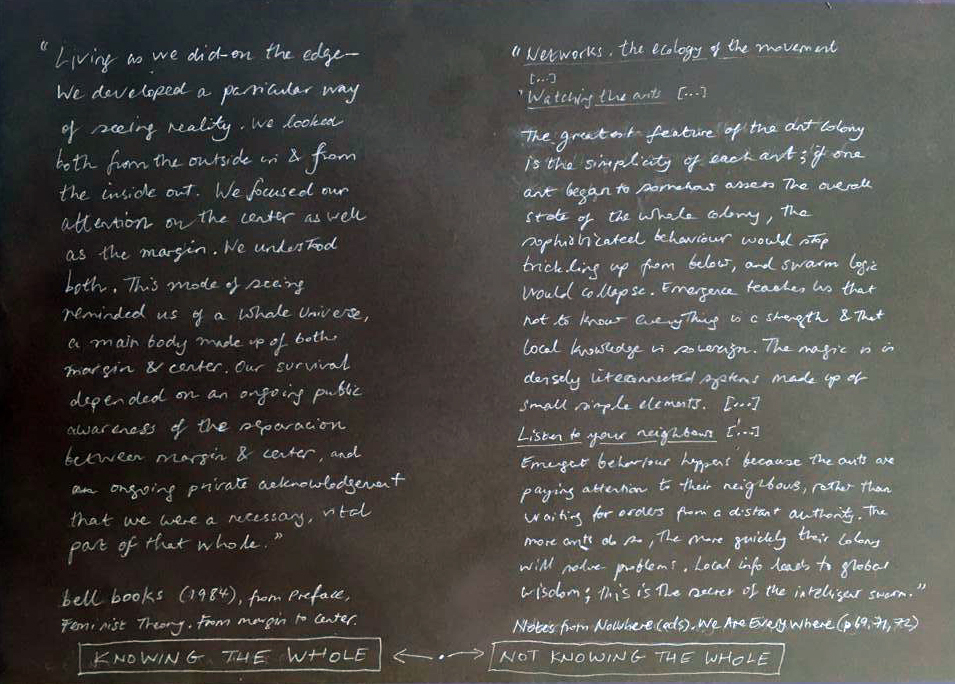
Knowing the whole: excerpt from Preface to 1984 Edition of bell hooks’ Feminist Theory. From Margin to Center. Not knowing the whole: excerpts from Notes from Nowhere (eds) (2003), We Are Everywhere (p. 69, 71, 72).… Knowing the whole + Not knowing the whole
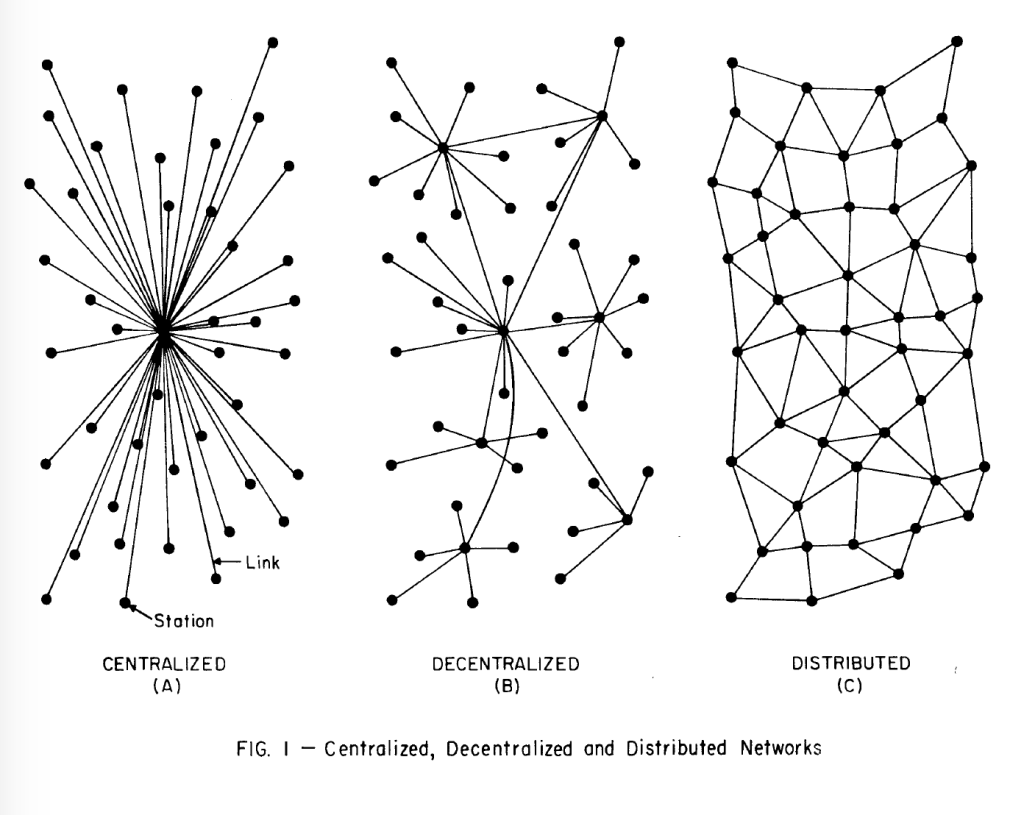
Excerpt from Preface to 1984 Edition of bell hooks’ Feminist Theory. From Margin to Center.Paul Baran’s network typologies from “On Distributed Communications”, a document prepared for the United States Air Force Project Rand (1964).
Baran’s network typologies from the early days of computing (1964) are still referenced by Tecnopolitica researcher-activists at the forefront of social transformation today (see diagram below). Decentralized and distributed networks, politics and technologies are at the heart of Tecnopolitical practices, however their politics are far removed from Baran’s context of US Air Force funded research. Politically, Tecnopolitica would have more in common with the trajectory of bell hooks whose framework: emphasises ‘the centre’ (contrasted with the margin); suggests ‘the decentering of the West globally’ and a focus instead on ‘attention on the issue of voice. Who speaks? Who listens? And why?’ (p. 40, 1994); and continues to be a reference point today for people arguing for ‘decentering and decolonising knowledge’ (Moreno Figueroa, 2019).
However, the substance and vibe of the hooks’ text sends very different messages to these stylised network visualisations (above and below)….




 Friction Films